
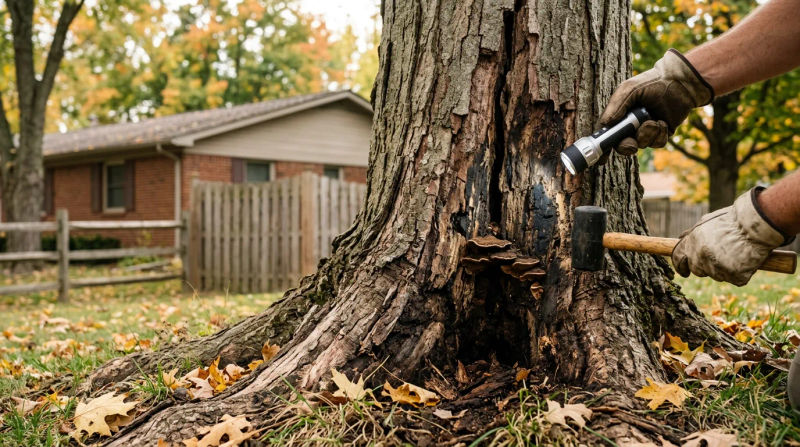
The autumn winds have arrived in Grove City, and as the leaves begin to fall, the true structure of the trees around your property is revealed. You might notice a large branch swaying more than you're comfortable with, or hear an unsettling creak during a gusty evening. It's a common concern for homeowners, especially in neighborhoods where mature trees stand close to homes, driveways, and fences. This time of year provides a critical window of opportunity to assess the health of your trees before the harsh Ohio winter sets in, bringing the added weight of snow and ice.
From my experience as a project superintendent overseeing landscape and construction work, I've seen firsthand how a seemingly healthy tree can hide significant structural problems. Paying attention to subtle clues now can prevent a catastrophic failure later. These are not just aesthetic issues; they are serious tree removal signs that warrant a closer look.
Common Signs and Symptoms
Identifying a potentially hazardous tree starts with a simple walk around your property. Our trained crews follow a standardized process for assessment, and you can use a similar checklist to spot potential problems. Look for these dangerous tree symptoms Grove City OH has been seeing more of as its trees mature.
- Significant Deadwood or Canopy Dieback: Look up. Are there large, leafless branches in the upper canopy? While a few small dead twigs are normal, branches that are an inch or more in diameter and are dead (often called “widow-makers”) are a major red flag. As leaves drop from the rest of the tree, these dead branches become much easier to spot.
- Cracked Trunk and Split Tree Warning Signs: This is one of the most critical indicators of an unstable tree. Look for deep cracks that penetrate the bark into the wood of the trunk. Pay close attention to where large limbs connect to the main trunk. Co-dominant stems that form a tight “V” shape are much more prone to splitting than wide “U” shaped unions. Any visible split is a sign of structural weakness.
- A Sudden or Pronounced Lean: Many trees have a natural lean, but if you notice a tree is leaning more than it used to, or if you see the ground heaving or mounding on the side opposite the lean, it could indicate root failure. This is an urgent warning sign, as the tree's entire support system is compromised.
- Fungus or Mushrooms at the Base: The presence of fungi, like mushrooms or shelf-like conks, growing on the trunk or near the base of the tree is a strong indicator of internal rot. The decay may have been progressing for years, and the fungus is simply the external symptom of a much larger, hidden problem.
- Cavities and Hollows: While not all cavities mean a tree must be removed, large hollows in the trunk or major limbs significantly reduce its structural integrity. If you can see daylight through a hole in the trunk, or if a large section sounds hollow when tapped, it needs a professional evaluation.
- Peeling Bark and Cankers: Sections of peeling or missing bark, or sunken areas on the trunk known as cankers, can point to a dead section underneath. This is another sign the tree is struggling to transport water and nutrients, leading to decay.
- Sprouts from the Base (Epicormic Shoots): When a tree is under severe stress, it may send up a flurry of small branches from its base or trunk. This is often a last-ditch effort to survive and indicates that the main canopy is likely in decline.
What Causes This Problem
Understanding why a tree becomes a hazard can help you spot risks earlier. The issues we see on job sites are rarely caused by a single event, but rather a combination of factors over time.
Many homes in the Grove City area, particularly those built in the 1990s and 2000s, feature trees that were either preserved during construction or planted shortly after. Now, two to three decades later, these trees are fully mature. Any root damage from that initial home construction - such as trenching for utilities or soil compaction from heavy equipment - can start to manifest as structural weakness. The tree may have looked healthy for years, but its compromised root system can no longer support its size.
Other common causes include:
- Age and Species: Some popular landscaping trees, like the Bradford Pear, are notoriously prone to splitting as they age. Other species simply have shorter, more predictable lifespans.
- Environmental Stress: The cycles of drought and heavy rain we experience in Central Ohio put immense stress on trees. Soil compaction in suburban lawns from foot traffic and lawnmowers also restricts root growth and access to water.
- Pest and Disease: Infestations like the Emerald Ash Borer can kill a tree in just a few years. Fungal diseases can work more slowly, hollowing out a tree from the inside while it still appears healthy on the outside.
- Storm Damage: A previous storm may have created a crack or broken a limb, creating an entry point for decay and insects. This damage can worsen over time until the tree reaches a breaking point.
When to Call a Professional
While it’s good to be an informed homeowner, tree assessment and removal are not DIY projects. The risks of property damage, utility line interference, and severe personal injury are simply too high. Our technicians undergo extensive safety training and use specialized equipment to manage these complex situations.
The key question is when to remove a tree before winter Ohio weather arrives. Fall is the ideal season for this work. The ground is still firm, and removing a hazardous tree now eliminates the risk of it failing under the heavy load of a winter ice or snow storm. Waiting until a tree is encased in ice makes the work far more dangerous and complicated.
You should call for a professional inspection immediately if you see:
- A new or worsening lean with soil lifting at the base.
- A deep, fresh crack in the trunk or a major limb.
- More than 50% of the tree appears dead or is in decline.
- Large branches are hanging broken over your home, driveway, or a neighboring property.
An experienced professional or certified arborist can provide a thorough risk assessment. They can determine if strategic pruning can save the tree or if removal is the only safe option. They have the expertise to see subtle signs of decay and structural instability that an untrained eye would miss.
Conclusion
Your trees are a valuable asset to your property, providing shade, beauty, and value. However, a hazardous tree is a significant liability. By being observant this fall, you can identify potential tree removal signs before they become an emergency. Pay attention to the overall health of the canopy, inspect the trunk for cracked trunk split tree warning signs, and look for any changes in the tree's lean or the soil around its base.
Don't wait for a winter storm to test the limits of a weak tree. Acting proactively is always safer and more cost-effective than dealing with the aftermath of a failure. An organized workflow from a team of trained professionals ensures the job is done safely and efficiently.
If you notice any of these signs, contact a local professional for an inspection. They can provide the expert guidance you need to keep your property safe.